
Cayman Islands Wall diving formation: The Ancient Origins of Our Iconic Dive Sites.

Updated: Sep 2
Cayman’s walls. These are vertical drops situated on a vast underwater mountain range known as the Cayman Ridge. But those iconic swim-throughs and intricate tunnels aren't simple erosion. They are formed by a combination of geological fracturing and aggressive, massive coral growth.
The Two Mechanics of Swim-Through Formation:
1. The Geological Foundation & Structural Fracture: The walls often began as dramatic limestone fissures, caverns, or faulted rubble originating from historic storm events. These original structures left large gaps, canyons, and "cracks" in the underlying Tertiary rock foundation that overlies the Ironshore unit.

2. Massive Coral Growth (Vertical Accretion): The magic happens when coral colonies settle on this fractured base. In high-energy wall environments, "massive" coral colonies grow primarily upward (vertical accretion) faster than they grow outward. These "towering" pinnacles and massive coral heads eventually bridge across existing gaps or fissures in the rock, creating fully roofed structures.
Through this combination of preexisting geological fractures being bridged by massive, upward-accreting coral architecture, the "Big Tunnels" and other complex canyons and chimneys are born. Over vast periods, these structures are shaped further by erosional processes, storm debris channeling, and dissolution, creating the intricate arches and tunnels we explore today.
The View from the Wall: Scale and Topography

Before entering a swim-through, take a moment to look up the wall face. What you are seeing is the scale of this ancient foundation. You can often pinpoint the deep vertical fissures and fractured topography that established the groundwork for massive coral architecture to take hold and begin building towers.
Entering the Labyrinth: The Swim-Through
When you glide through a tunnel on the wall, remember you are moving through a void created by biology growing over fractured geology. Looking out towards the deep blue emphasizes the incredible, towering scale of these bridged structures.
Spurs and Grooves: Nature’s Breakwaters
If you are diving on the shallower fore-reef (typically 5–10 meters deep), you will notice a distinct, finger-like topography of coral ridges separated by sand channels. This morphology is known worldwide as Spur and Groove (SAG).
For a long time, scientists debated whether these were purely erosional features—ancient gullies carved during lower sea levels—or if they were built actively.
We now know that in the Cayman Islands, SAG systems are primarily constructional features. They are built up actively by corals (Acropora palmata, Porites astreoides, Diploria spp.) flourishing in high-energy environments. Wave energy and trade winds drive swells over the reef, and the high-energy surge channels effectively prevent coral growth in the channels, maintaining deep, sand-filled grooves.
Conversely, the corals build seaward-oriented, wave-aligned spurs. These parallel ridges function as natural breakwaters, significantly reducing wave energy reaching the coast.
Why They Matter (More Than You Think):
New research has quantified that SAG structures are more important for energy dissipation than previously reported. Wave dissipation friction factors (fw) can be four times higher than on other reefs. Crucially, the wave energy dissipation rate over the spurs can be up to three times higher than over the grooves (e.g., 0.098 vs. 0.028 kW/m2).
This means the live coral covering the spurs is directly responsible for the critical coastal protection service provided by the reef. Any loss or change in the structure of this live coral could have profound consequences for the shoreline defense. The grooves, meanwhile, serve as efficient conduits for moving sediment off the reef slope, preventing the smothering of corals on the spurs.
Chasing Sediment: The Groove
The standard dive view of SAG is moving along the channeled sand. When you look down a deep, U-shaped groove, you are looking at a highly efficient sediment conduit bordered by high-relief, coral breakwaters.
The Bird's Eye View: Parallel Defense

To truly appreciate how the SAG system operates, you need an aerial perspective. From above, the repeating, parallel, finger-like organization of the Spurs (built of live coral) separated by Grooves (channels of sand) is evident. This repeating pattern is a powerful natural breakwater architecture.
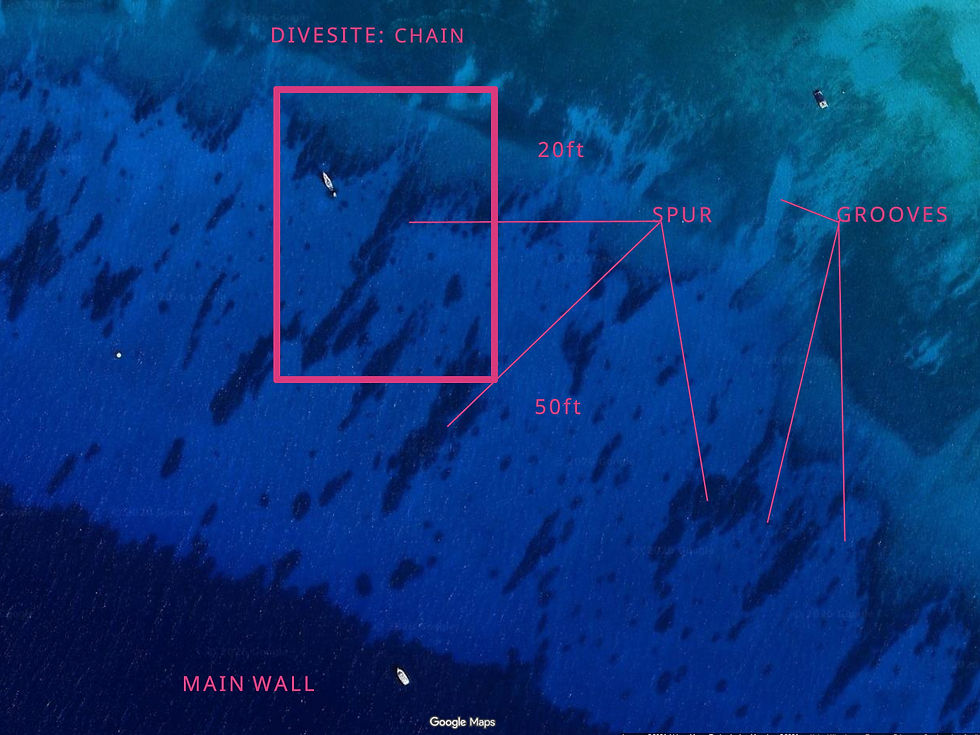
The next time you are enjoying the stunning walls, intricate tunnels, or channeled shallow reefs of Grand Cayman, take a moment to look at the geology. You are moving through a masterpiece sculpted by ancient high seas, massive constructional biology, and enduring wave energy.
See you on the wall! —The Divetech Team
Reference Articles:


Comments